“I Need a CFO”—Why Many Owner/Operators Hire for the Wrong Role
“I need a CFO” is one of the most common things owner/operators say to me as their
businesses grow—and one of the most misunderstood. The confusion isn’t surprising. Titles
get thrown around loosely. Often, what they mean—or need—is someone to clean up the
books, keep them compliant, and/or tell them where the money actually went. That’s not a
CFO. That’s a controller or a strong bookkeeper (C&B)—a distinction that matters. CFOs and
C&Bs are built for different jobs and shaped by different training and focus. Hiring for the
wrong role delays clarity, drains resources, creates frustration and, worse, drives bad decisions.
Yes, this topic has been tackled and discussed many times before in countless forums and discovery discussions. This article isn’t about job descriptions you can easily look-up. Rather, my voice is intended to help practically tell when a CFO is needed versus a C&B.
The Core Difference: Tactical vs. Strategic
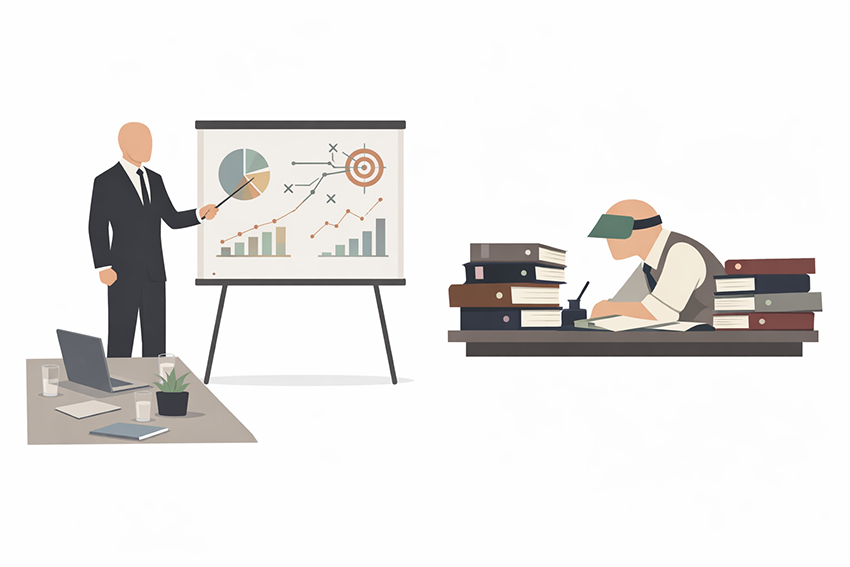
At a high level, the difference is simple—C&Bs are tactical and backward-looking while CFOs are strategic and forward-looking. C&Bs primary focus is capturing data—accurately—and in compliance with accepted accounting rules and practices. They answer whether the numbers are correct. CFOs, on the other hand, shape strategy and are focused on understanding what the data is saying so as to drive and make decisions. Yes, there is overlap and “gray area”— particularly in start-ups and small companies. And, yes, specific responsibilities and needs will vary across businesses, growth stages and company cultures. However, the basic differentiation and primary focus is the key to hiring for the right role.
What C&Bs Actually Are…and When You Need One
C&Bs exist in accounting with a controller being the accounting head. As we mentioned above, they make sure the financial data is accurate, complete, and compliant. To test or check whether you are primarily looking for someone in the C&B bucket, think about the questions you are asking, the challenges you are tackling and the duties you are looking to off-load:
- “I don’t trust my books” and “Do we even have usable data?”
- “My financials don’t really tell me anything.”
- “Can we make payroll?” and “How much cash do we actually have?”
- “Are we GAAP-compliant?” and “What are our receivables and payables?”
These are all focused on the past and whether we can rely on the data at which we are looking. C&Bs are critical for cleaning up and maintaining the general ledger, ensuring transactions are recorded correctly, “closing” the books, ensuring financials are reliable, tracking receivables/payables, and generally, keeping the company out of trouble. Their background is typically accounting with primarily accounting, audit and/or tax experience. Many times, they are “Big Four” and have a knack for detail, compliance, and financial hygiene. If your business is reactive, running on “how we’ve always done it,” and you lack confidence in your numbers, a C&B is the right next step.
What a CFO Actually Is…and When You Need One
A true CFO is a strategist sitting in the finance seat, whose job it is to turn data into insights and insights into decisions. CFOs are leaders and growth drivers. Revisiting the questions above, the CFO “needs test” could include:
- “How do we grow this business sustainably?” and “Where should we place bets [i.e., investments] and where must we make an investment?”
- “What happens if we change pricing, mix, or cost structure?” and “What are the second and third-order effects of this decision?”
- “What does this business look like in 12, 24, or 36 months?” and “How do we maximize our chance to achieve success?”
- “How do we convert revenue into cash faster?”
Notice a difference? CFOs are forward-looking, comfortable making judgment calls in ambiguous situations, and bring clarity to complex decisions. CFOs help shape and translate strategy into financial reality—they recognize and work the linkages between strategy and finance. Said differently, they are a strategic thought partner to the CEO. They are the home of financial modeling and scenario analysis. They drive capital allocation and investment decisions as well as evaluate growth opportunities and risks. Many times, they come from corporate finance, FP&A, consulting, I-Banking and even strategy. (Among large public company CFOs, only around 38% hold CPA credentials, while around 52% have MBA degrees.1) CFOs use accounting data—but don’t live there. They assume the data is reliable and then ask, “What does this mean for where we’re going?”
Not All “CFOs” Are Created Equally
Here’s where many businesses go wrong. They hire someone with a CFO title who spends most of their time fixing the books and focusing on historical reporting while avoiding modeling and ambiguity and decision making. If you find yourself in this situation, the question to ask is why? Is it that you hired the wrong person OR, as is often the case, is the organization not ready for a CFO. A good CFO knows decision making is reliant on clean, reliable data. If your books and data is not clean, you can hire a CFO, but they’ll spend their time doing C&B work to set the stage for CFO responsibilities. You’ll pay more and get less value.
CFOs often sit close to strategy. In many organizations, the head of strategy reports to the CFO—not because finance “owns” strategy, but because the CFO is trained to translate strategic intent into economic reality. This is why a CFO can look at imperfect data and still help you make a better decision—while a C&B may insist the data be perfected first.
Other Considerations
Make sure you are honest with yourself about control. If you want to keep decision-making tightly in your own hands, hire a C&B. However, if you want a thought partner who challenges your thinking and shapes decisions, that’s a CFO. Many companies do not need a full-time CFO for a variety of reasons including volume of work, existing expertise on the leadership team, and company growth stage. This can still be true if both CFO and C&B skills are needed. Fractional CFOs and C&Bs could be an excellent solution. You can receive the skills you need and a cost and frequency that fits your company where it is.
Final Thoughts
C&Bs and CFOs both play crucial roles, but they solve different problems. The former provides clean data that drives better operations and compliance whereas the latter provides insights from data that drives better strategic and financial decisions. Knowing what you really need—and when—can save you money, frustration, and, most importantly, from bad decisions.
¹Volatility Report, Summer 2024, CristKolder Associates