 In the previous article, we discussed a firm with strategic errors producing financial symptoms—resources misaligned with priorities, growth stalled. That’s the direction most assume causality flows. But causality runs both ways. Financial failures produce strategic symptoms with equal frequency. And when it runs “backward,” the broken links can be harder to find, because the problem doesn’t appear where you’d expect it.
The good news is that there are observable cause-and-effect rela
tionships that can be captured by six Disconnect Rules-of-Thumb. The rules can signal when strategy and finance disciplines have disconnected regardless of causality direction. (See wheel graphic.)
THE CASE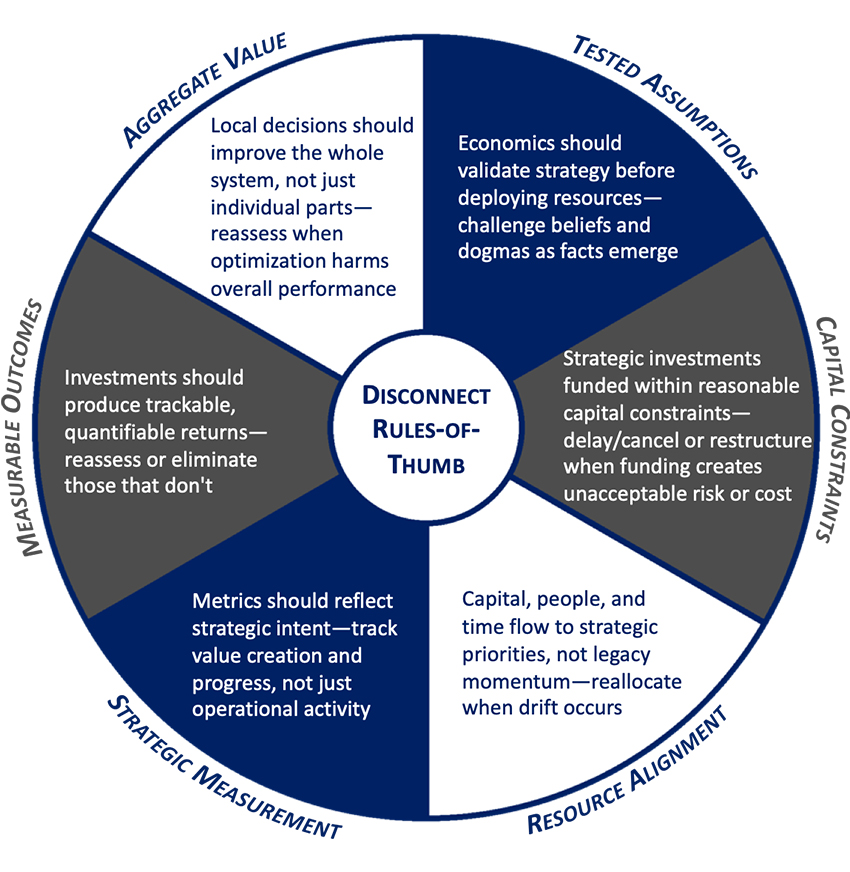
Consider a firm where a constant cash crunch persisted despite robust revenue activity. Services delivered on time. Bills sent out. Yet the company wasn’t making money. A cash scramble was the norm. Infusions needed just to keep operating. Margins were unknown. EBITDA couldn’t be articulated. Utilization was a mystery. Decisions were made by gut in lieu of analysis, because “[they’ve] always done it this way.” Quality was central to the value proposition but so was costly over-delivery.
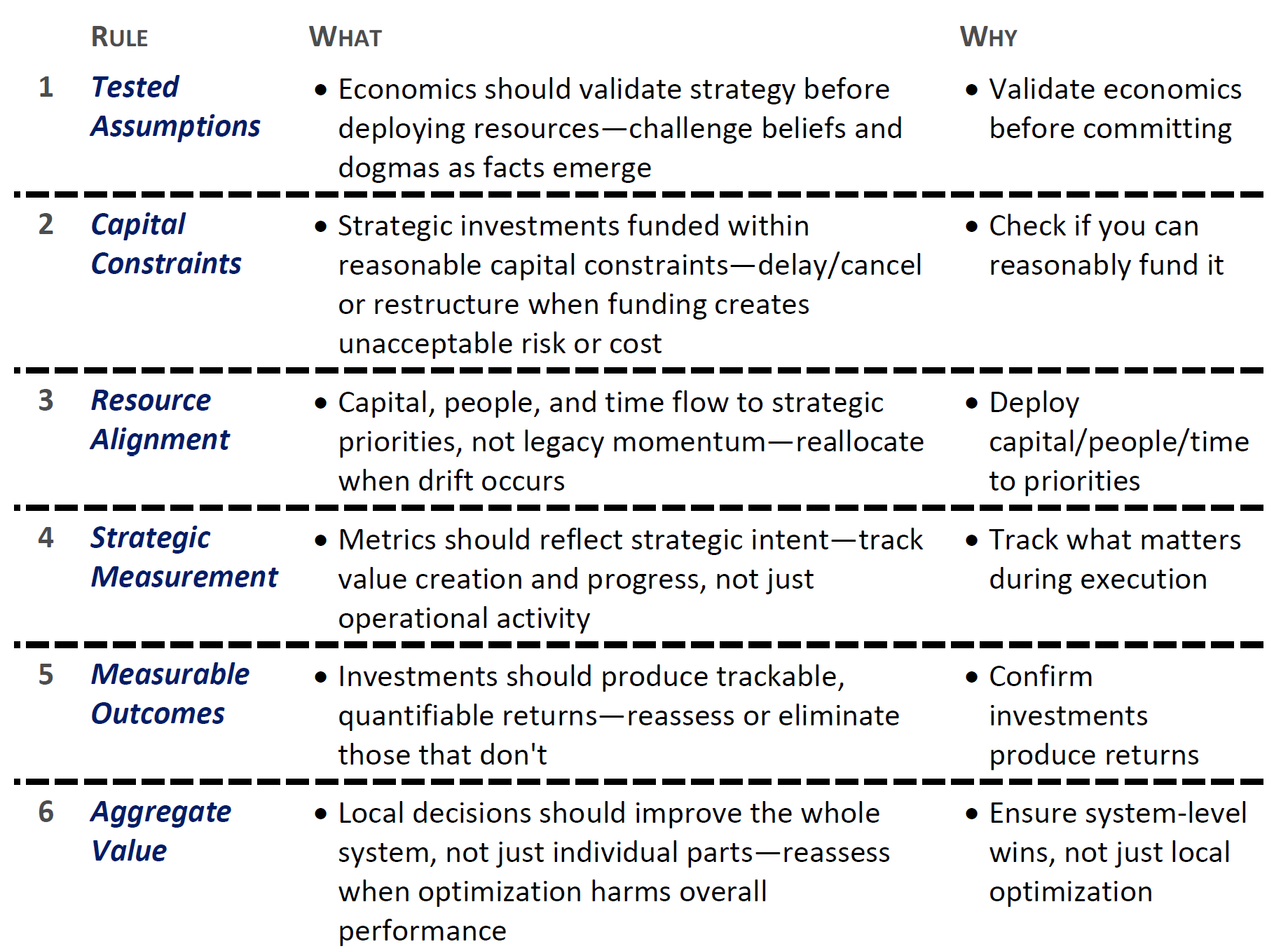
When business was good, payroll increased well beyond what sustainable growth could support. We applied the rules-of-thumb and found multiple broken links. Strategic Measurement was broken—without knowing what to measure, they couldn’t track whether strategic activity was producing value. So we rebuilt financial visibility connecting activity to margin and utilization. Tested Assumptions was broken—they never validated whether their delivery model actually created profitability. So we helped identify which activities created value versus costly over-delivery that clients didn’t reward. Resource Alignment was broken—headcount expanded beyond sustainable levels while leadership scrutinized minor expenses and ignored major cost drivers. So we right-sized capacity and refocused resource attention on what actually moved profitability. We addressed the structural issues and set them up to continue the transformation independently. The firm stabilized and continues operating today. Revenue increased 11%, and their cash cycle dropped by approximately 13 days.
THE LESSON
For clarity and illustrative purposes, we chose a blended case with relatively visible disconnections. However, the rules’ real value emerges when diagnosing deeply embedded breaks that don’t loudly announce themselves. Without these Disconnect Rules-of-Thumb, diagnosis becomes trial and error. With them, broken links reveal themselves through observable patterns, regardless of which direction causality runs.
Supported by a Culture of Integration, Shared Understanding, Testing Practice, and Committed Leadership—see the first article, “The Integration Imperative”—as well as these rules, you can prevent breaks and surface weak links early, before they compound into crises. And when the links between strategy and finance are strong, your path to sustainable growth is clearer and more attainable.
The Six Disconnect Rules-of-Thumb Table—Excerpt